
 Shane Edwards
Money worries are something many Australians are familiar with. But they don’t just affect your bank account. They can follow you to bed and keep you up at night. Simply opening a letter can make your heart pound. These aren’t extreme circumstances. They’re actually very common financial stress symptoms, and they affect more people than you might imagine.
Help is at hand. This guide looks at what Australian research says about financial stress and health and the main signs to watch out for. We’ll also examine exactly what Revive’s own client records show. Most importantly, we’ll tell you where to find free support.
What follows is general information, not medical or financial advice. If you’re in crisis or feel unsafe, call Lifeline on 13 11 14, or 000 in an emergency.
What Are the Financial Stress Symptoms to Watch For?
Attributing symptoms to financial stress isn’t always simple, as there’s no single checklist. Remember that many of the signs overlap with other things. Always treat them as a prompt to check in rather than a diagnosis.
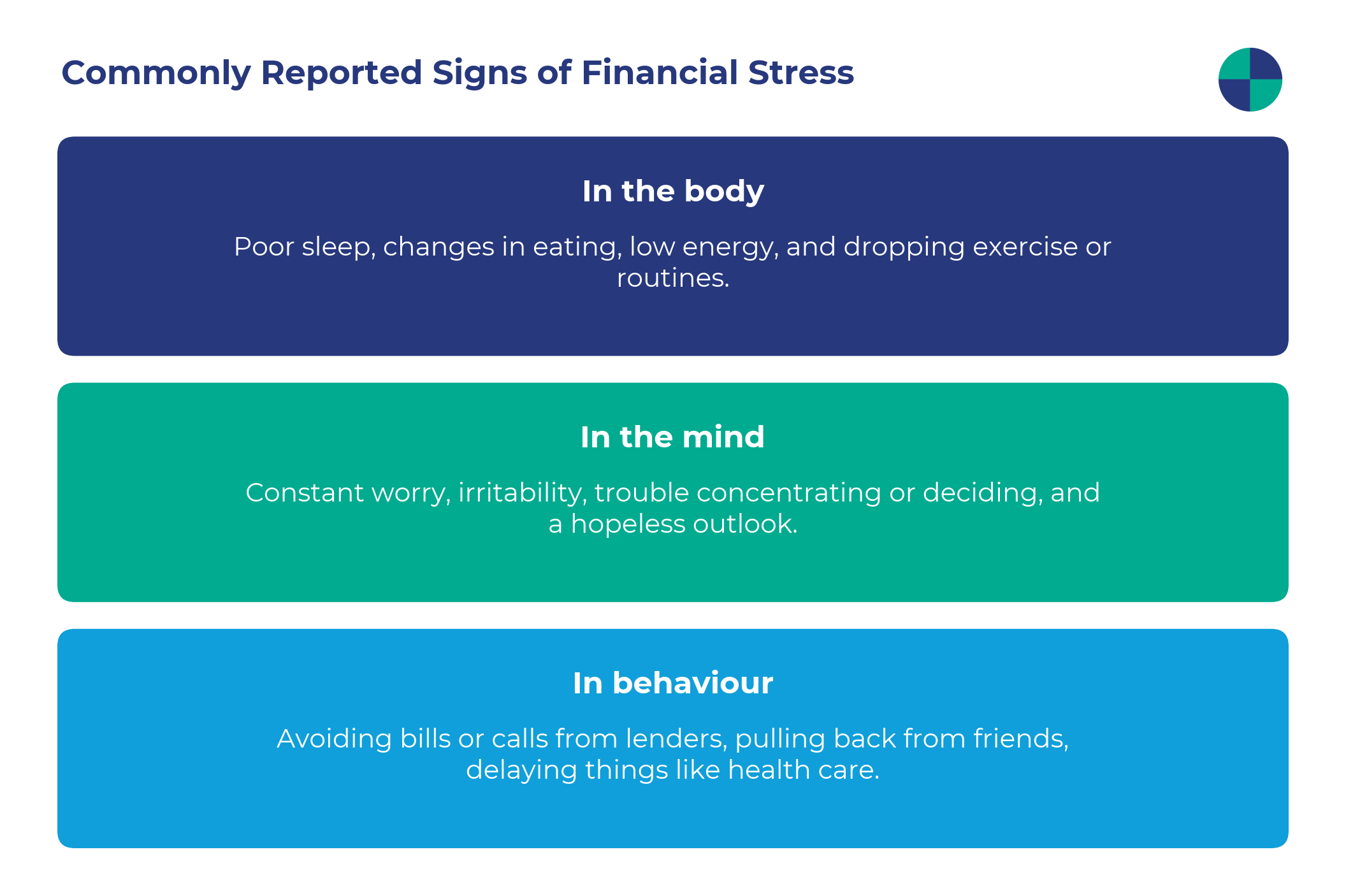
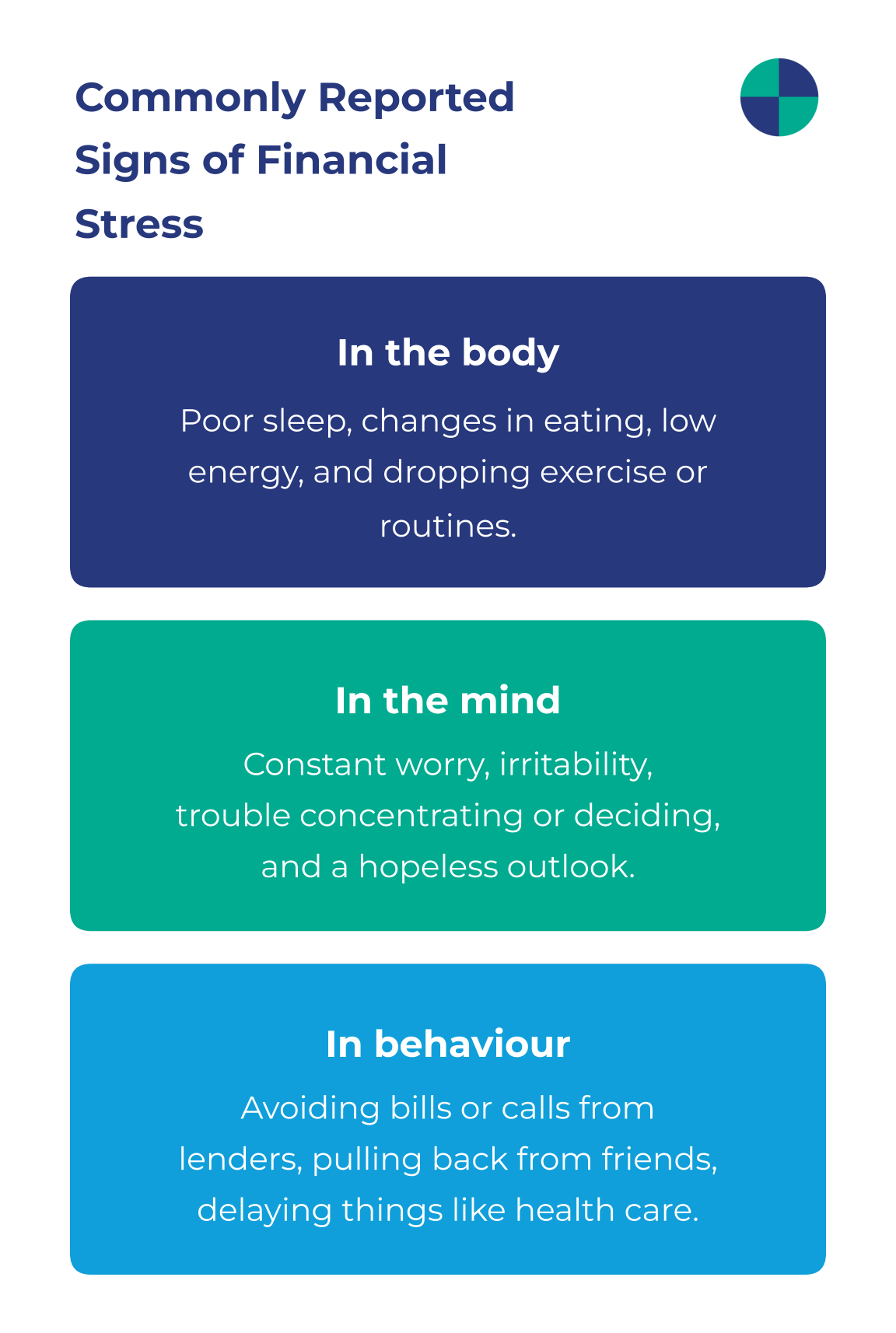
Beyond Blue lists many signs to watch for when money and mental health collide, including:
- Very poor sleep
- A poor diet
- Dropping physical activity
- Avoiding lenders and creditors
- A hopeless outlook
What is money anxiety?
Money anxiety is a common way of describing a constant worry about money that doesn’t switch off, even when nothing is due. It isn’t a clinical diagnosis, but it’s a real experience. If it’s affecting your sleep, mood, or daily life, you should talk to your GP.
How Common Is Financial Stress in Australia?
It’s more common than most people assume, and it’s on the rise: The Australian Institute of Health and Welfare’s (AIHW) long-running HILDA Survey put the figure at 13% in 2023, up from 11% in 2022.
This study is designed to measure financial stress, which it defines as two or more hardship events in a year. That could be, for example, not paying a bill on time or going without meals.
This graph shows which Australians report the most financial stress:

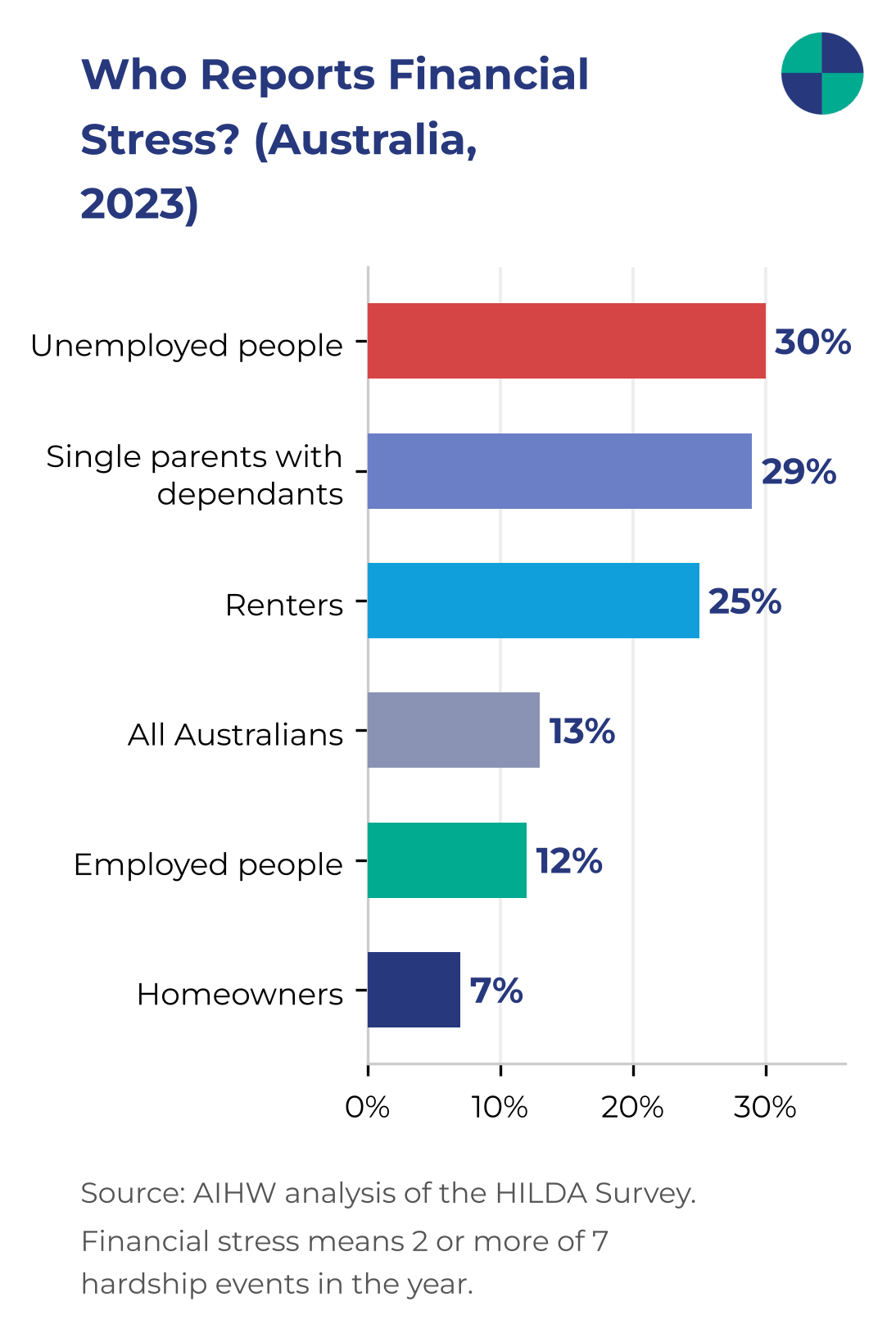
Unemployed people (30%), single parents with dependants (29%), and renters (25%) reported the highest levels, while homeowners reported 7%.
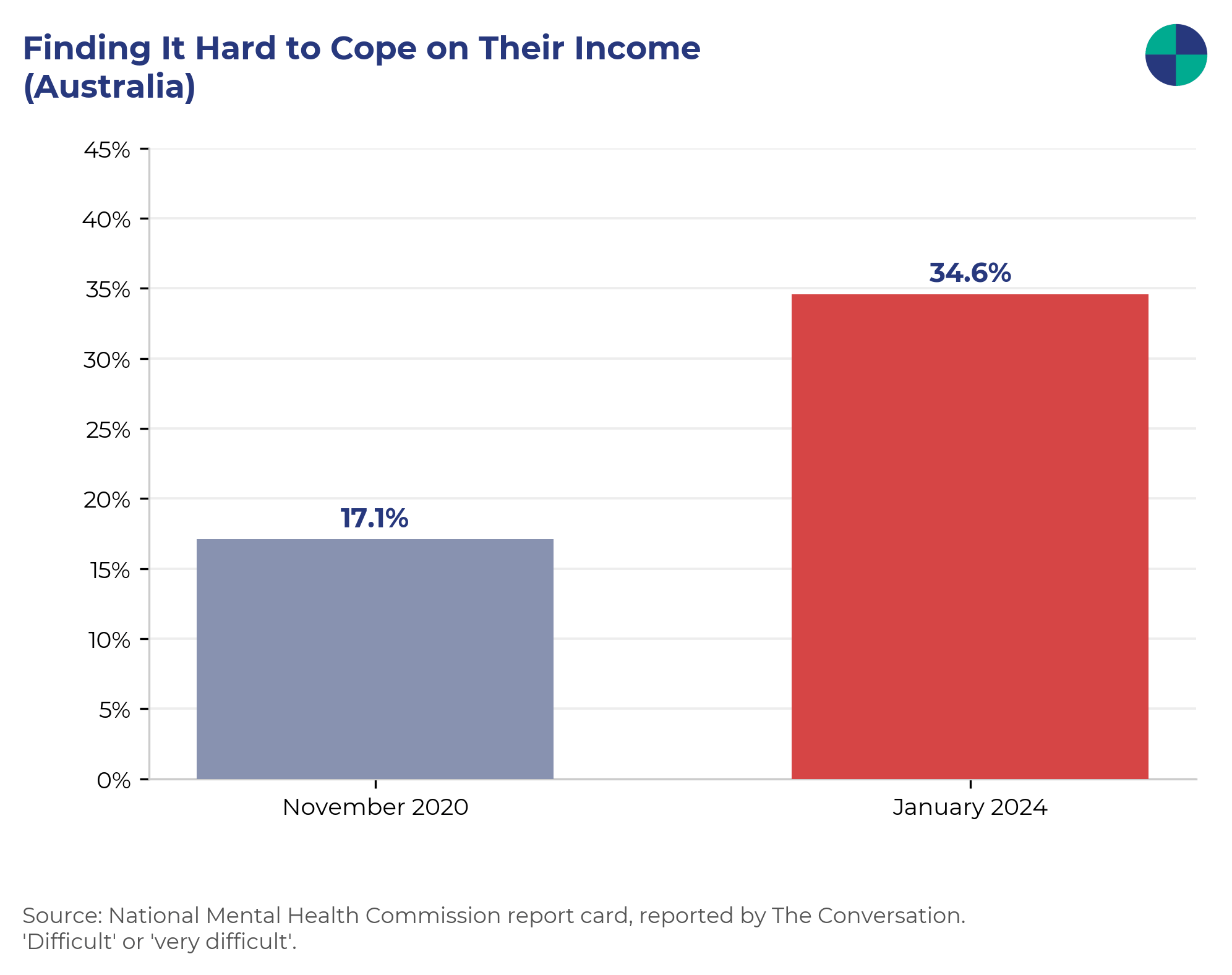
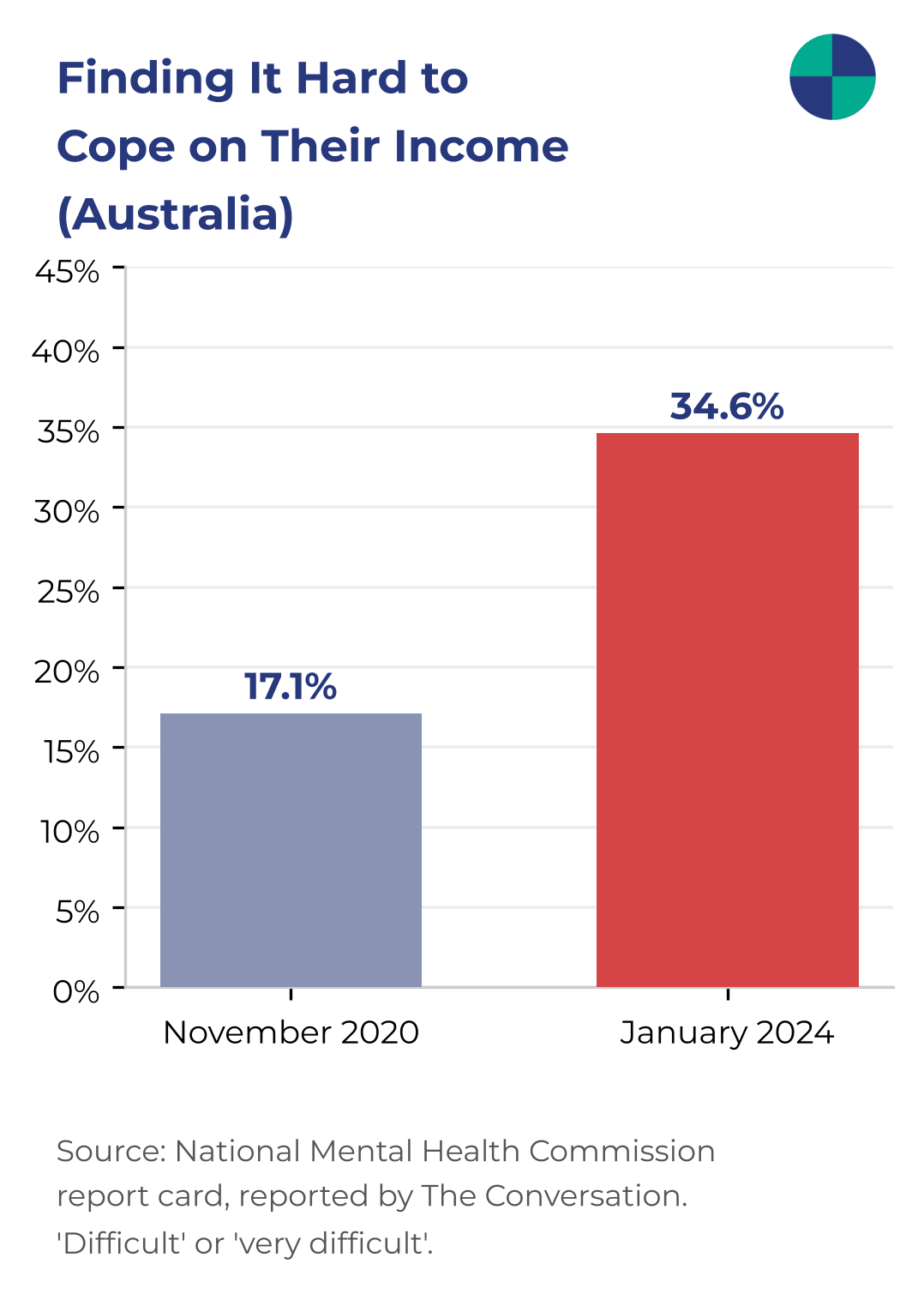
However, it’s important to remember that financial stress is about circumstances, not character. For example, the National Mental Health Commission found that the share of people finding it difficult or very difficult to cope on their income doubled from 17.1% in November 2020 to 34.6% in January 2024.
Who Is Most Affected by Financial Stress Symptoms?
The AIHW found that women reported financial stress more often than men in 2023 (14% compared with 11%), and that single mothers with dependent children reported the highest level of any family type at 31%.
Place matters as well. Financial stress was 25% in the most disadvantaged areas of the country and 6% in the most advantaged, and 16% in outer regional areas compared with 12% in major cities.
None of this means financial stress symptoms only affect people on low incomes. It means the pressure is heaviest where costs are high, income is tight, or support is thin, and it can reach anyone when circumstances change quickly.
How can you tell everyday worry from something more serious?
Everyone worries about money sometimes. It’s not always serious. However, you should take note if the anxiety:
- Lasts for weeks
- Affects your sleep, work, or relationships
- Leaves you feeling hopeless
At that point, talk to your GP or call Beyond Blue or Lifeline. If you ever have thoughts of harming yourself, call Lifeline on 13 11 14 or 000 straight away.
What Does Research Say About Financial Stress and Health?
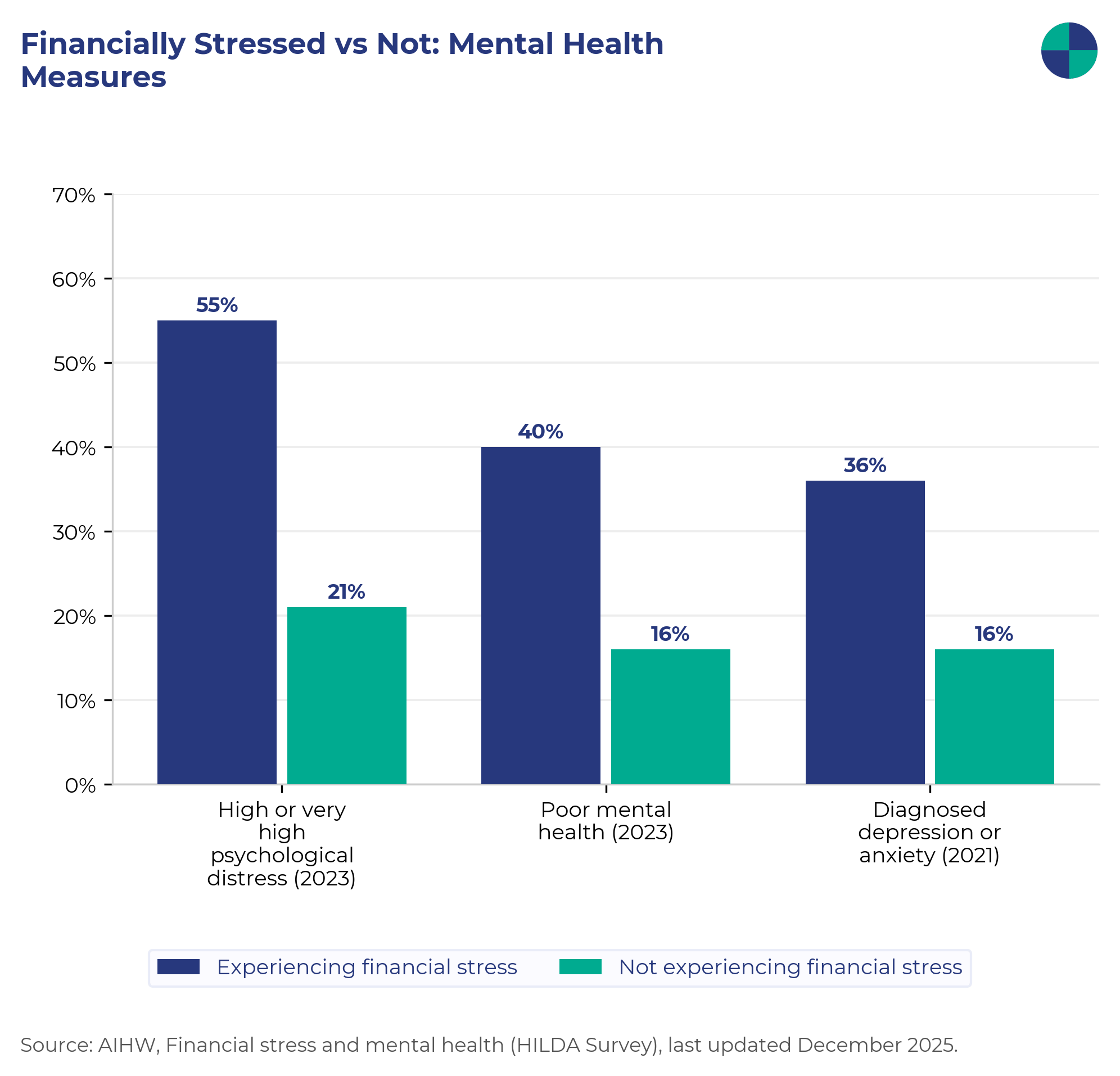
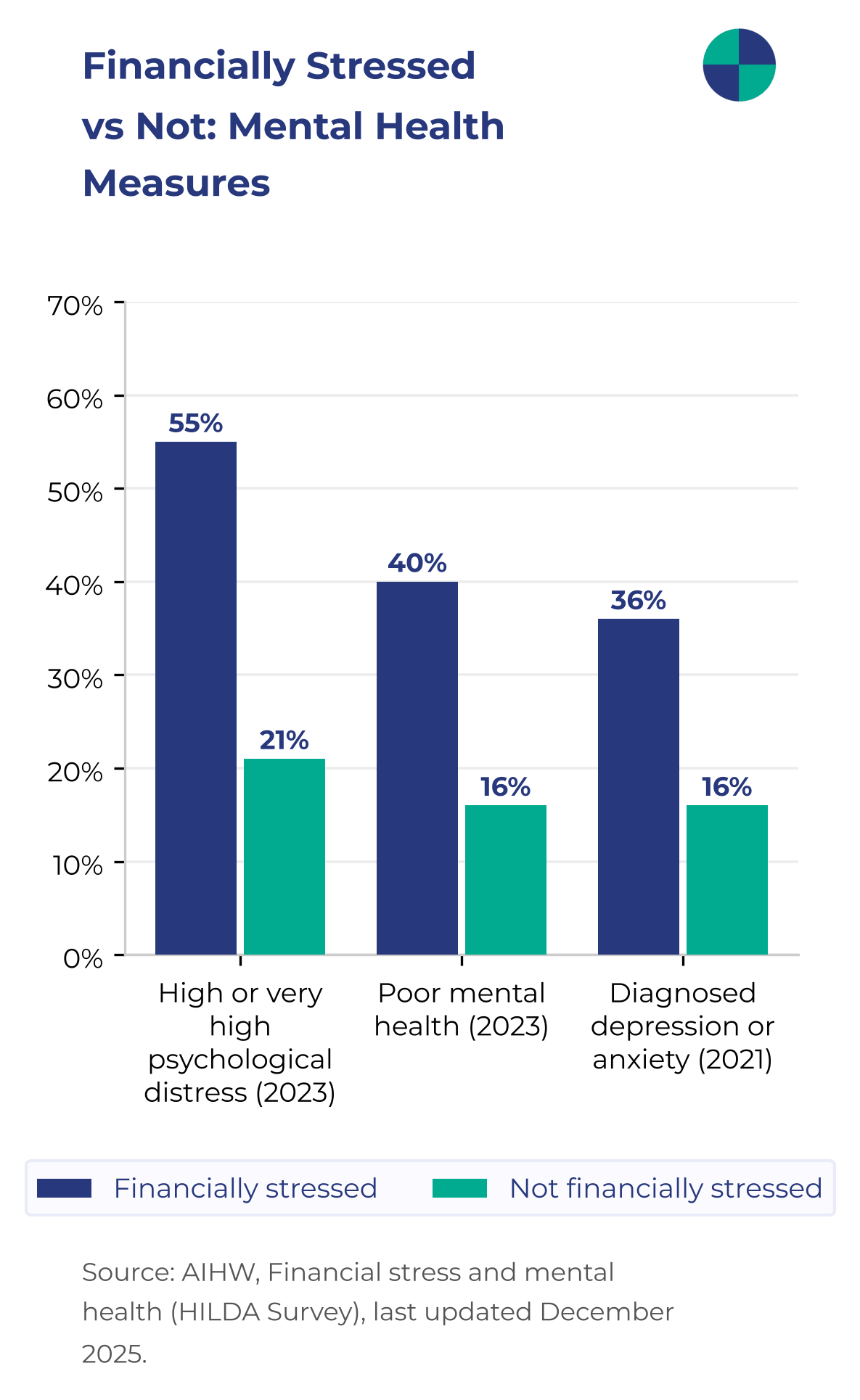
Financial strain can affect your health. The AIHW found that by 2023 almost 55% of financially stressed Australians reported high or very high psychological distress. That’s around 2.6 times the rate of people who weren’t financially stressed. Poor mental health was also 2.5 times as common, at 40% compared with 16%.
There may also be a link between financial stress and general health, too. In 2023, 24% of people who rated their general health as poor also reported financial stress, compared with 11% of those with good general health. However, the AIHW makes it clear that there’s a stronger link between mental health and financial stress than general health.
Also bear in mind that these are associations, not proof of cause. It’s often a two-way relationship: financial stress can contribute to distress, and poor health can make it harder to manage money, hold work, or ask for help. That’s part of the reason financial stress symptoms can be so hard to shake.
Is Money Anxiety a Cause or a Result?
Research shows it’s not necessarily as simple as one or the other. It can actually be both. Poor finances can be a result of anxiety, but anxiety can clearly also be a result of poor finances.
Housing is a good example. Among people experiencing financial stress, 47% of renters reported poor mental health in 2023, compared with about 33% of homeowners. The AIHW points to the insecurity renters face, such as limited control over where they live.
The practical point is that money anxiety isn’t a personal failing. It’s a reasonable reaction to real uncertainty. Reducing that uncertainty is often the most effective way to reduce the worry.
What Do Revive Client Records Show?
Our records show what clients named as reasons for their debt rather than what caused what. They also describe Revive’s clients only, not all Australians, and people who contact us tend to have some capacity to repay, so people on very low or no income may be under-represented.
Across all records, 16.8% of clients named illness as a reason for their debt (16.7% in 2025). Casual and part-time workers named it more often than full-time workers.
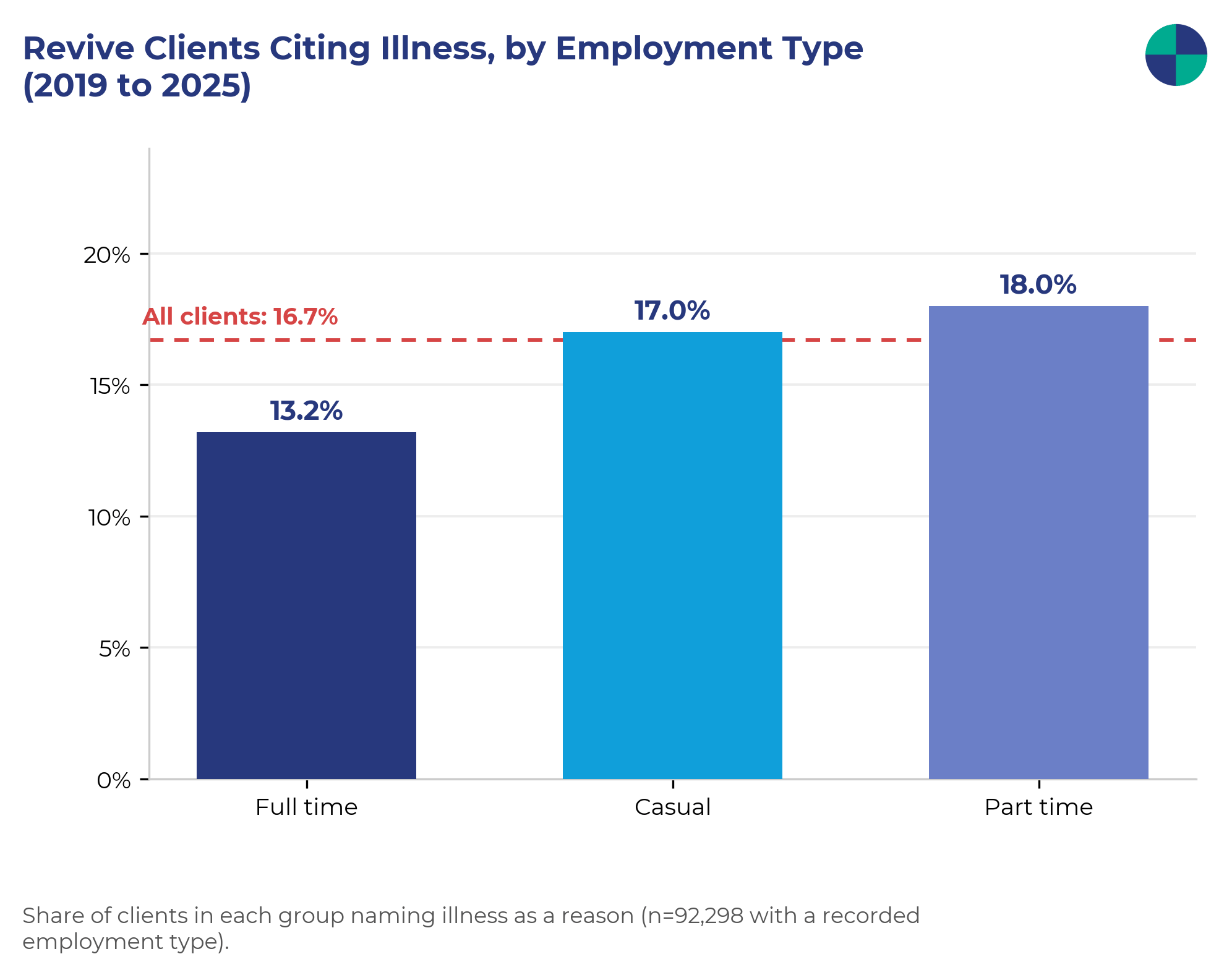
We can see that illness and money problems often coincide. Among records naming illness and at least one other listed reason, 25% also named job loss. Of clients who answered our question about repayments, 73.5% said they were behind. Those clients are living with the pressure that sits behind the financial stress symptoms in this article.
Why Do Bills and Letters Feel So Threatening?
Avoiding lenders, bills, and calls is one of the most common financial stress symptoms, and it’s easy to understand. Not looking feels safer than seeing an impossible repayment. But it’s not sustainable. Missing important correspondence can:
- Add late fees
- Narrow your options
- Turn a manageable problem into a bigger one
It’s not easy to get over a fear of bills and letters. However, you can take small steps to ease the burden. A good place to start is to set a fixed 20-minute window once a week to open everything, write each amount and due date on one page, and stop when the time is up.
Seeing the whole picture on paper often shrinks it, and it gives you something concrete to take to a lender’s hardship team or a free financial counselling service.
What Can You Do When Money Worry Starts to Weigh on You?
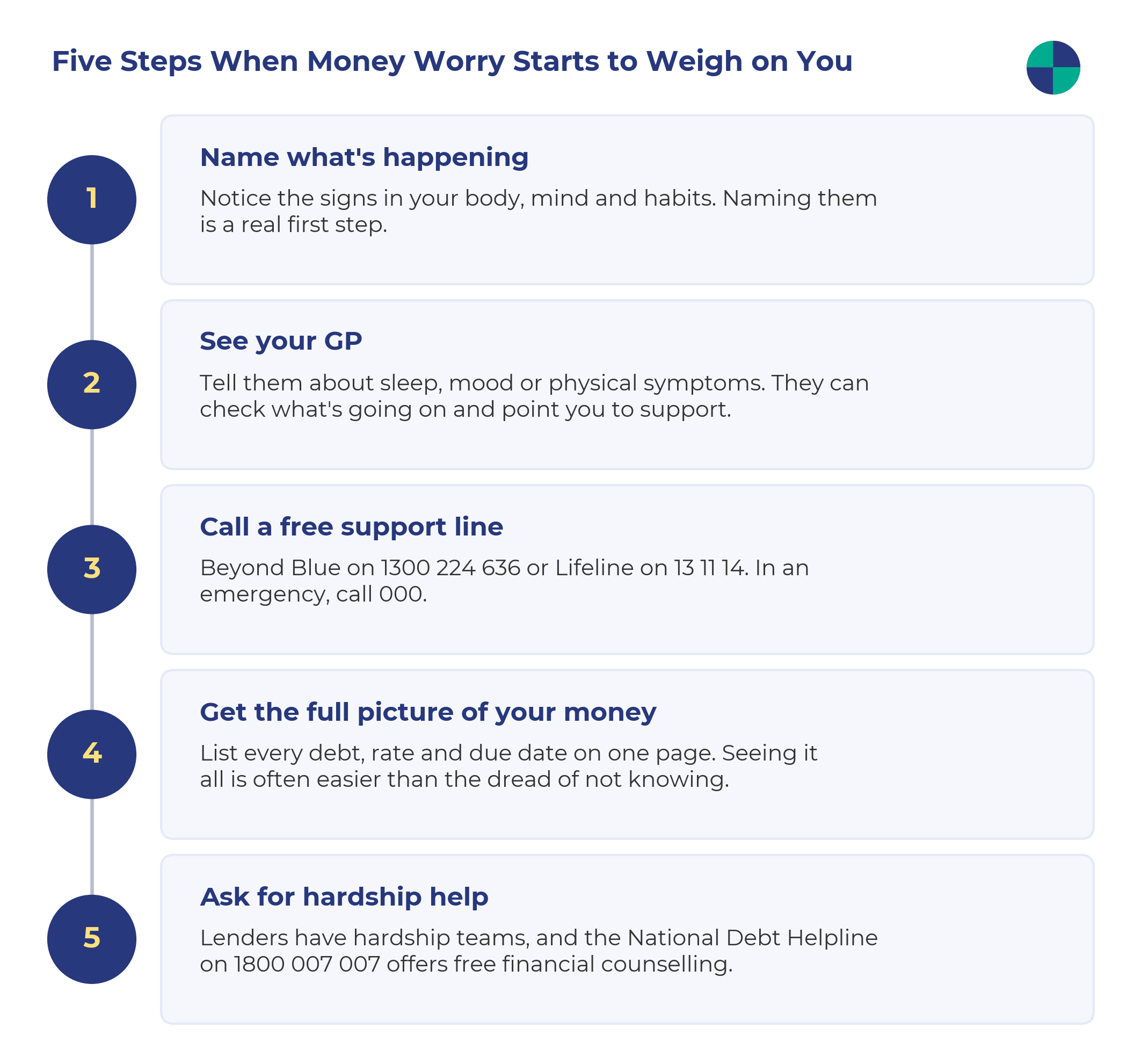
Young people can also contact headspace on 1800 650 890. If your worry is mostly about debt, the free National Debt Helpline can explain your options without any pressure.
Sam’s Story (Illustrative)
Sam, a hypothetical 36-year-old, had been sleeping badly for months and had stopped opening letters from lenders. He told his GP about the sleep, who suggested he get support for the worry itself as well.
He then listed every debt on one page, rang two lenders’ hardship teams and called the National Debt Helpline. The debts didn’t vanish, but they stopped being unknown, and for Sam that was where the pressure started to ease. Outcomes differ for everyone.
This example is illustrative and doesn’t describe a specific individual. It isn’t medical advice.
When Does It Make Sense to Talk to Revive?
Revive Financial isn’t a health service, and we can’t advise on your health. However, if unsecured debt such as credit cards, buy now pay later, or personal loans is a big part of the worry, we offer a free, no-obligation assessment so you can see your options. Any option depends on your circumstances and on creditors agreeing, and none suits everyone.
Looking After Yourself While You Sort the Money Out
Financial stress symptoms are extremely common, but you should still pay attention to them. They often suggest there’s action you could be taking.
Tell your GP how you’re sleeping and feeling, use the free support lines when things feel heavy, and take one practical step on the money side this week, even if it’s only listing your debts. You don’t have to fix everything today. Talk to Revive Financial Success Specialists.
General information only. This article isn’t financial, legal or tax advice, and Revive Financial can’t advise on your superannuation or Centrelink entitlements. Rules, rates and figures are as at October 2026 and can change, so check the sources named and your own provider. Outcomes vary and depend on your circumstances and, for debt options, on creditor agreement. Revive Financial: RDAA 1337 (Debt Agreement content) and ACL 503321 (credit content). Last updated: 8 October 2026.